Subtotal $0.00
Grade 1 — mild
Mild fat deposition. Often reversible through lifestyle change alone, which is why this is the grade where early testing pays off the most.

Specialist gastroenterology, liver and pancreas care in KPHB Colony, Kukatpally. Sunday OPD, evening hours and on-site FibroScan.
Fatty liver treatment in KPHB begins with an accurate scan, never a guess. Dr. Viswanath Kamisetty leads liver care at Gokul Gastro & Liver Care, KPHB 13th Phase, and the clinic runs an on-site FibroScan machine, so you learn your fat grade and stiffness score during the same visit. Many residents discover fatty liver during a routine health check-up, but a scan report alone rarely explains the real risk — our team reads those numbers, links them to your metabolic profile, and builds a plan you can follow.
Fatty liver treatment in Hyderabad usually means long queues at large corporate hospitals. Instead, this clinic offers evening hours and Sunday OPD, and one DM-qualified specialist handles your case from the first scan onwards, so your reports stay with a single doctor.
Monday – Saturday
Sunday
Fatty liver means fat collects inside your liver cells, a condition doctors call steatosis. A healthy liver normally stores very little fat, and once fat crosses five per cent of liver weight, the diagnosis applies. Early fatty liver rarely causes pain — instead, it quietly changes how your body handles sugar and cholesterol, which is exactly why fatty liver disease treatment works best at this silent stage, before scarring has a chance to build.
NAFLD treatment in KPHB targets non-alcoholic fatty liver disease. Global guidelines recently adopted a newer name, MASLD, short for metabolic dysfunction associated steatotic liver disease — both labels describe the same underlying problem. Alcohol-related fatty liver follows regular drinking, and some patients carry both drivers together, which is why the treatment plan always has to match the true cause rather than a generic protocol.
Left alone, trapped fat slowly inflames the liver, and over time that inflammation creates scar tissue called fibrosis. Heavy scarring can eventually turn into cirrhosis, and fatty liver also raises your risk of diabetes, heart attack and stroke — good liver care protects far more than the liver alone.
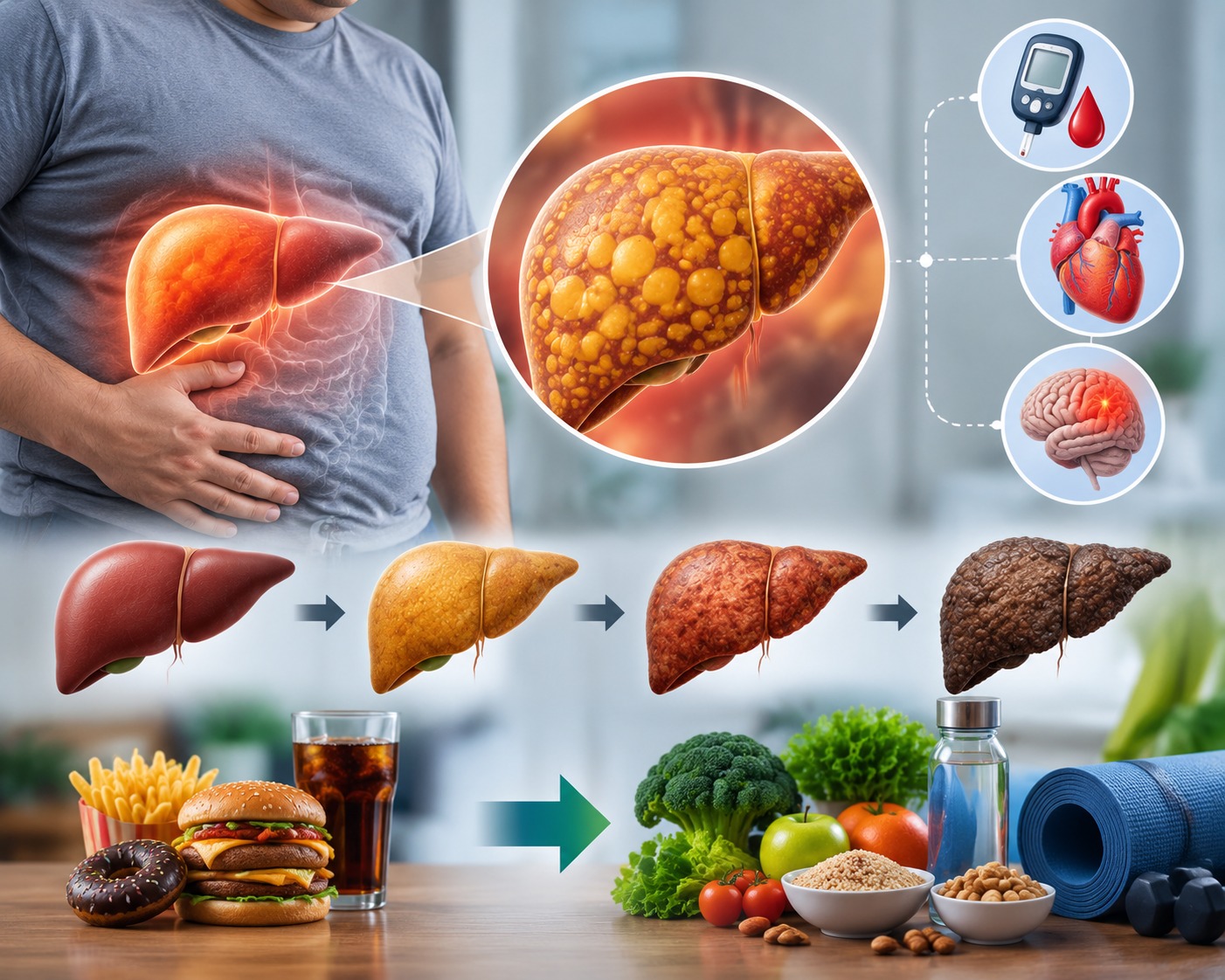
Two separate scales describe your liver. Grade measures how much fat sits inside, and stage measures how much scarring has formed — so one report may show heavy fat yet zero scarring.
Mild fat deposition. Often reversible through lifestyle change alone, which is why this is the grade where early testing pays off the most.
Moderate fat deposition. Needs medical review and regular monitoring rather than diet changes alone.
Severe fat deposition, carrying a higher risk of inflammation and scarring. This is the grade where fibrosis staging matters most.
Most people feel completely normal during the early years. Still, several quiet signals should prompt a check-up.
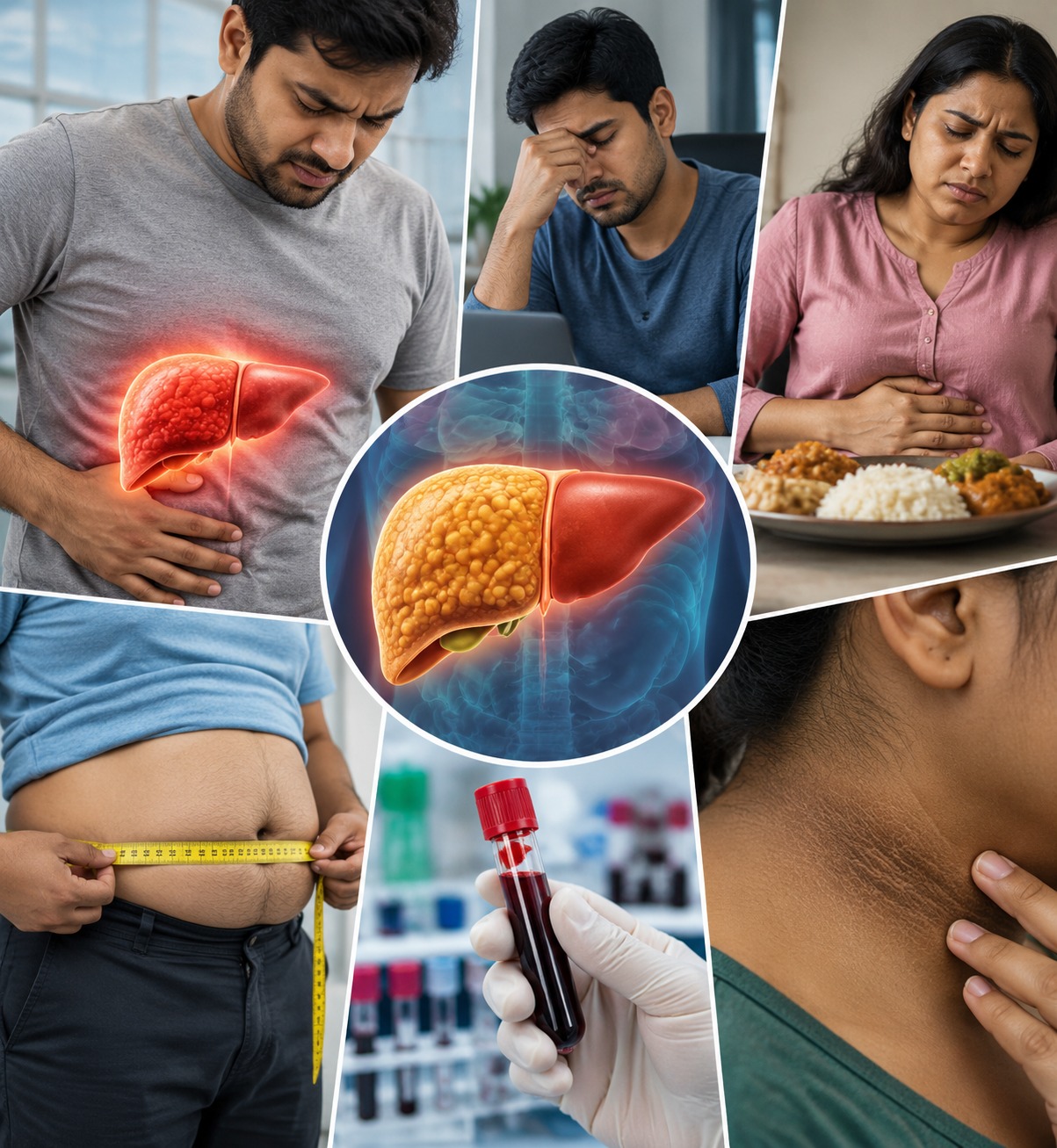
A heaviness rather than sharp pain, often dismissed as gas.
Fatigue that persists despite adequate sleep.
Discomfort that follows oily, heavy or late dinners in particular.
A gradual shift in body shape rather than a sudden change.
SGPT, SGOT or GGT flagged slightly high on a routine blood report.
Acanthosis nigricans, a visible sign linked to insulin resistance.
Later stages behave differently. Swelling of the feet suggests reduced liver function, yellowish eyes point towards deeper liver stress, and easy bruising or poor appetite can appear as scarring progresses — at that point, an early appointment with a fatty liver doctor in KPHB remains the safer choice.
Most cases trace back to one of three drivers, and the treatment plan always follows whichever one applies to you.
Insulin resistance drives most cases seen in our clinic. Obesity, type 2 diabetes and high triglycerides all push extra fat into liver cells.
Hypothyroidism and PCOS contribute strongly to fatty liver risk, often alongside the metabolic drivers rather than in isolation.
Many slim patients also develop lean fatty liver. Insulin resistance can exist despite a normal weight, so a normal BMI doesn't rule it out.
Regular alcohol intake injures liver cells directly, and some patients carry both an alcohol and a metabolic driver together.
A few medicines raise liver fat on their own — steroids, tamoxifen and certain antiviral drugs appear on that list, so always share your complete medicine history during consultation.
Sugary drinks and packaged juices, deep-fried snacks cooked in reused oil, late dinners followed by immediate sleep, long sitting hours with very little walking, and crash diets that trigger rapid rebound weight gain.
A clear sequence, in this order — history first, then blood work and scans, then grading and a plan.
Weight history, diabetes, alcohol use, medication list and family history. This shapes which tests matter most for your case.
Done inside our own clinic, finishing within ten minutes with no needles, no dye and no sedation. You lie down while a probe rests against your right side, and receive CAP and kPa values immediately — fatty liver treatment in KPHB starts without any diagnostic delay.
Liver function tests covering SGPT, SGOT, GGT and bilirubin; fasting glucose, HbA1c and insulin; a complete lipid profile; thyroid function; viral markers for hepatitis B and C; and a FIB-4 score calculated from these routine values.
Detects fat reliably but cannot measure scarring on its own. FibroScan quantifies fat and stiffness together, which is why the two are read side by side.
Rarely necessary today. Unclear or conflicting results, or suspected autoimmune or overlapping liver disease, may justify the step — otherwise, non-invasive tests answer nearly every question.
No single tablet cures this condition. Instead, fatty liver treatment in KPHB combines several proven levers, and Dr. Kamisetty selects the mix suiting your grade, stage and other illnesses.
Chosen when body weight is raised and fibrosis sits at F0 to F2. Losing roughly seven to ten per cent of body weight reduces liver fat sharply, and the same reduction can reverse early inflammation — so we set gradual, realistic targets rather than crash plans.
Chosen when diabetes, prediabetes or high triglycerides coexist. Several modern diabetes medicines lower liver fat directly, and controlling sugar protects against fibrosis progression, so we coordinate closely with your physician throughout.
Chosen when steatohepatitis is strongly suspected without diabetes. Selected supplements reduce liver inflammation in suitable patients, but dosage needs specialist supervision — self-medication is never advisable here.
Chosen when alcohol contributes to ongoing liver injury. Stopping alcohol improves liver readings within weeks, and we guide you through withdrawal safely while nutritional correction runs alongside.
Chosen when FibroScan shows F3 or F4 readings. Advanced scarring needs structured follow-up, so we add six-monthly scans, endoscopy screening and liver cancer surveillance to the plan.
Real progress needs proof. We typically repeat FibroScan after six months, while blood tests every three months track inflammation — so you see measurable improvement instead of guesswork.
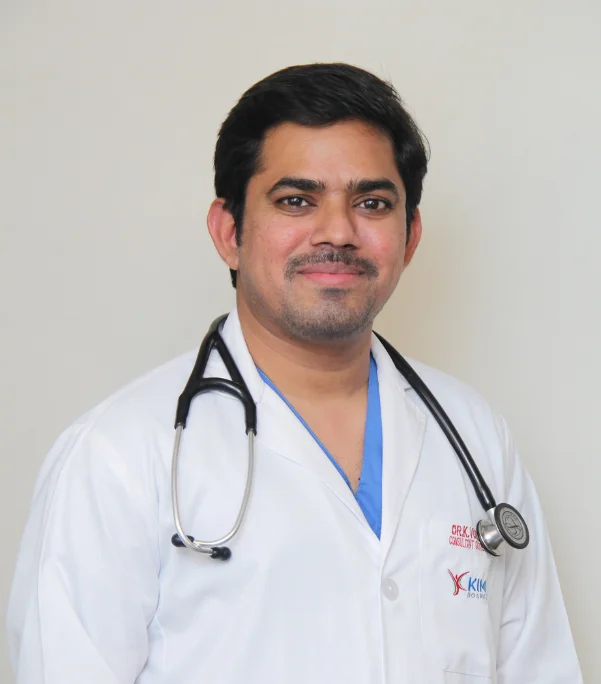
Consultant Gastroenterologist & Liver Specialist, Advanced Interventional Endoscopist — Gokul Gastro & Liver Care, KPHB · Medicover Hospitals, Financial District.
Dr. Viswanath Kamisetty holds MBBS, MD and DM in Medical Gastroenterology — DM represents the highest Indian qualification in this field. He treats liver, stomach, pancreas and intestinal conditions daily, and performs and interprets every FibroScan personally. Patients seeking a fatty liver specialist in KPHB often consult several general physicians first; here, you get direct access to one super-specialist, so care never shuffles between changing doctors. Anyone comparing options for a fatty liver specialist in Hyderabad gains locality convenience without losing clinical depth.
Fatty liver responds remarkably well to early, structured care, and accurate staging changes the entire plan — a scan-first approach beats guesswork every time. Fatty liver care in KPHB should fit around work and family, which is why we keep evening consultation hours and a Sunday OPD.