Pre-hepatic jaundice
Occurs before bilirubin reaches the liver, typically from excessive breakdown of red blood cells as seen in haemolytic anaemia or malaria. The liver cannot process the sudden overload, so bilirubin spills into the blood.
Specialist gastroenterology, liver and pancreas care in KPHB Colony, Kukatpally. Sunday OPD, evening hours and on-site FibroScan.
Plot No 10 & 11, 1st Floor, KSR Square, Gokul Plots, 13th Phase Road, KPHB Colony, Kukatpally, Hyderabad, Telangana 500085
Yellow eyes, yellow skin and dark urine usually mean bilirubin is building up in the blood — and the cause can be anything from a mild viral infection to a blocked bile duct. Jaundice treatment in KPHB at Gokul Gastro & Liver Care combines accurate testing with on-site FibroScan under Dr. Viswanath Kamisetty (MD, DM Medical Gastroenterology), so the root cause is found fast. Sunday OPD and evening slots for working patients.
Monday – Saturday
Sunday
Jaundice is not a disease in itself. It is a signal pointing to an underlying liver, bile duct or blood problem. Bilirubin, the yellow pigment formed when red blood cells break down, builds up in the bloodstream and turns the eyes, skin and mucous membranes yellow.
Normally the liver processes bilirubin and clears it through bile. When that process breaks down, bilirubin accumulates — and patients notice yellow eyes, itchy skin, pale stools and darker urine. Because these signs can mean anything from a mild viral infection to serious liver disease, they need proper evaluation rather than a wait-and-watch approach.
A simple blood test reveals the level within minutes. A total bilirubin above 1.2 mg/dL in adults suggests jaundice, and levels above 3 mg/dL usually cause visible yellowing. Every jaundice diagnosis in KPHB starts with this basic but essential test, and treatment never begins until the exact cause is confirmed.
Knowing which of the three types you have is what decides the treatment, so your jaundice specialist in KPHB classifies it by where the problem sits relative to the liver.
Occurs before bilirubin reaches the liver, typically from excessive breakdown of red blood cells as seen in haemolytic anaemia or malaria. The liver cannot process the sudden overload, so bilirubin spills into the blood.

Develops when the liver itself is damaged — viral hepatitis, alcohol- related liver disease and fatty liver disease being the common triggers. Long-standing damage can progress to fibrosis, which our on-site FibroScan detects without any invasive procedure.
Also called obstructive jaundice, this happens when bile flow is blocked after leaving the liver. Gallstones, bile duct strictures and pancreatic problems are frequent causes, and the blockage backs bilirubin up into the bloodstream.
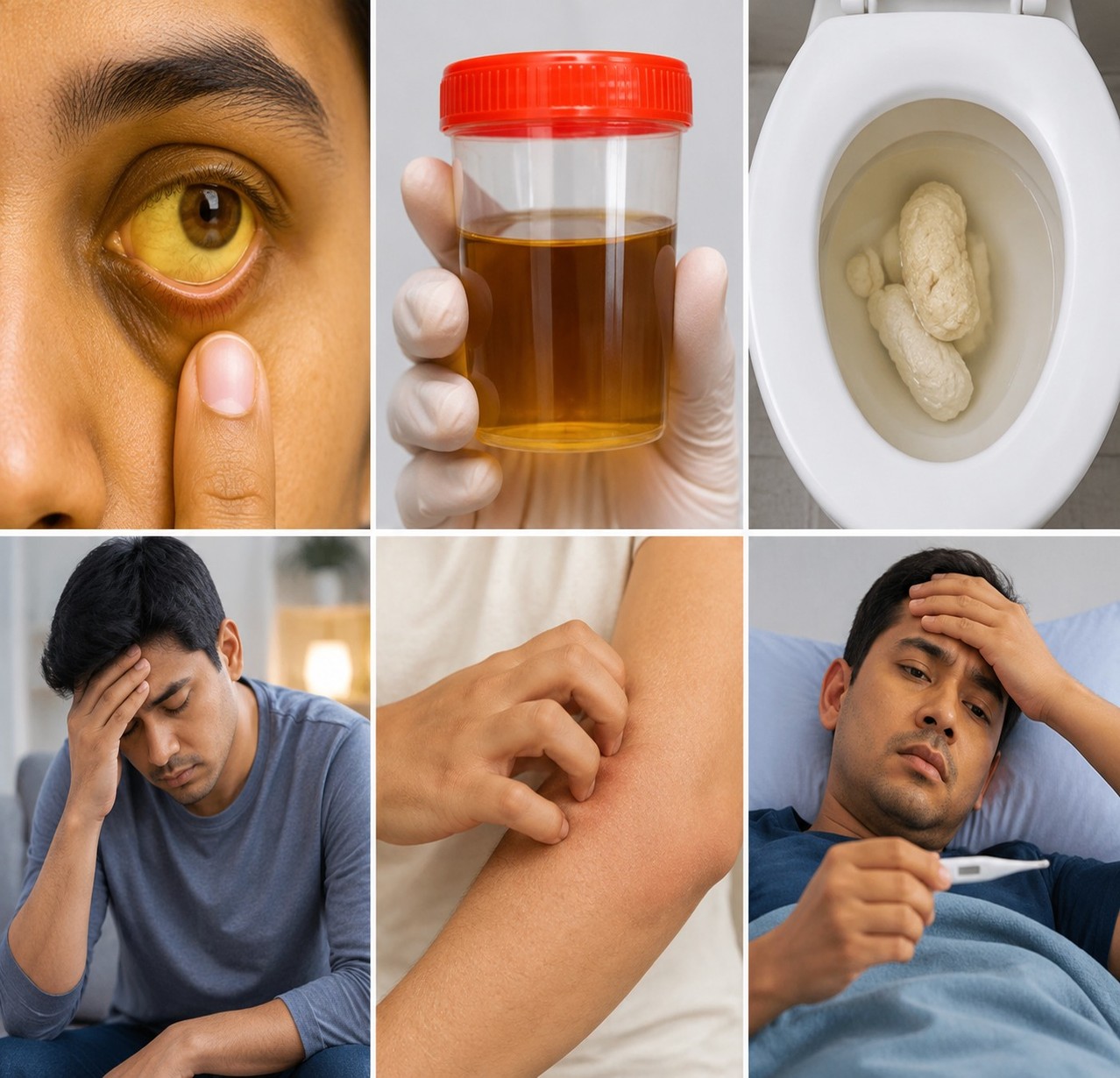
Recognising the signs early leads to faster recovery. These are what patients most often report before coming in for jaundice care in KPHB.
The whites of the eyes usually turn yellow before the skin does. Check them in natural light, not under indoor lighting.
Tea or cola coloured urine that has no obvious link to low fluid intake.
A sign that bile is not draining into the gut as it should.
Unexplained tiredness, particularly alongside a change in urine colour, should never be ignored.
Generalised itching caused by bile salts building up under the skin.
Often points to a viral or infective cause that needs confirming.
Each cause demands a different treatment, so we never guess. The exact trigger is confirmed through targeted tests before any bilirubin treatment in Hyderabad begins.
Viral hepatitis (A, B, C and E), alcohol-related liver disease, non-alcoholic fatty liver disease, autoimmune liver conditions, and certain medications or herbal supplements taken without supervision.
Gallstones blocking the bile duct, bile duct strictures or narrowing, tumours of the pancreas or bile duct, and bile duct injury following earlier surgery.
Haemolytic anaemia, malaria and certain other infections, and inherited conditions such as Gilbert's syndrome, where bilirubin processing is mildly impaired from birth.
A structured sequence, in this order — each step decides whether the next one is needed.
Total, direct and indirect bilirubin are measured together. The split between direct and indirect is what narrows the diagnosis to a pre-hepatic, hepatic or obstructive cause.
LFTs check enzyme levels, protein levels and clotting factors. A complete blood count runs alongside to rule haemolytic causes in or out.
Measures liver stiffness and fat content painlessly. Unlike a biopsy it takes only a few minutes and gives instant results, so an accurate liver picture comes without an invasive procedure.
Checks for gallstones, bile duct dilation and blockages — the first imaging step whenever an obstructive cause is suspected.
CT or MRI for detailed bile duct imaging, hepatitis viral markers, and autoimmune antibody panels. Ordered on the basis of what the earlier steps showed, not as a routine bundle.
Once the cause is confirmed, the plan is built around it. These are the four routes your jaundice doctor in KPHB will choose between.
Chosen when liver inflammation or infection is the primary cause. Treatment uses targeted medication, antiviral therapy where needed, and close monitoring of liver enzymes. The exact combination follows your test results, with repeat blood tests tracking bilirubin throughout.
Chosen when gallstones or strictures block bile flow. ERCP clears the blockage and places a stent where necessary. Because it avoids open surgery, recovery is shorter and bilirubin starts falling soon after the duct is cleared.
Chosen when gallstones repeatedly cause obstruction or complications. Laparoscopic gallbladder removal is the recommended route — a minimally invasive operation that resolves recurring jaundice rather than treating each attack in isolation.
Chosen when jaundice comes from a self-limiting viral infection. The focus stays on hydration, rest and nutrition while the liver heals on its own, with bilirubin monitored closely so any complication is caught early.
For reference, a total bilirubin between 0.1 and 1.2 mg/dL is generally considered normal in adults. Anything beyond that range means further evaluation is warranted.
Consultant Gastroenterologist & Liver Specialist, Advanced Interventional Endoscopist — Gokul Gastro & Liver Care, KPHB · Medicover Hospitals, Financial District.
Jaundice always signals that something inside the body needs attention, and ignoring yellow eyes or dark urine only delays proper care. Same-week appointments, Sunday OPD and evening slots — take the first step toward clearer eyes and a healthier liver.
Monday – Saturday
Sunday
WhatsApp us